Professional monitoring can add another layer of response to a home security system, but it also introduces an ongoing monthly expense. Whether you need professional monitoring for home security depends on how you use your system, how quickly you can respond to alerts, and the level of assistance you want when an alarm occurs.
Understanding the differences between professional and self-monitoring can help you decide which approach makes sense for your home.
What Is Professional Monitoring?
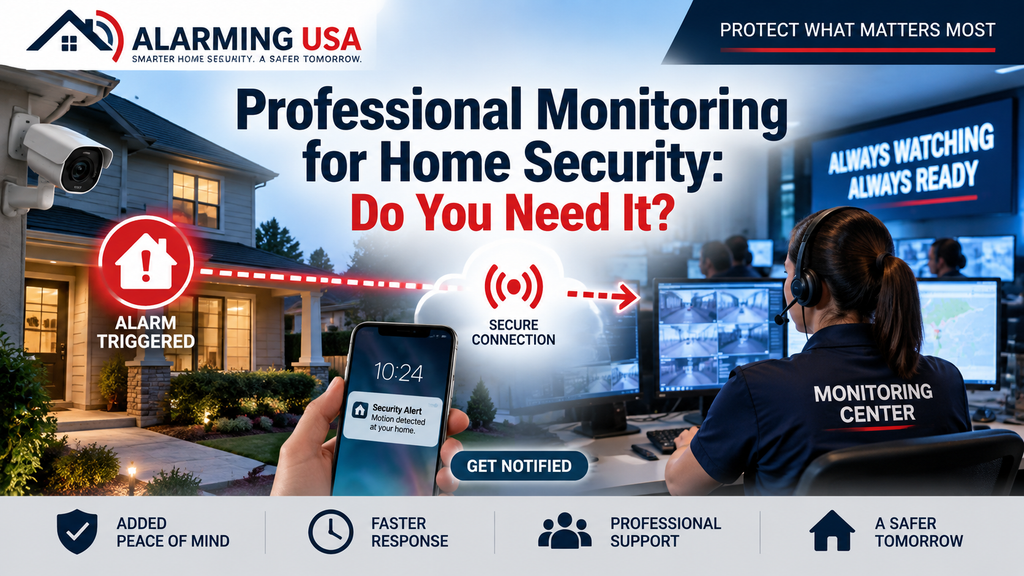
Professional monitoring connects supported alarm events from your security system to a monitoring center.
When the system reports an alarm, trained operators can follow established procedures for that type of event. Depending on the alarm, monitoring provider, account instructions, and applicable requirements, this may involve attempting to contact you or requesting assistance from emergency services.
Professional monitoring doesn’t mean someone is continuously watching everything happening inside your home. Traditional alarm monitoring generally involves responding to signals generated by the security system.
How Does Professional Monitoring Work?
Although procedures vary between providers and alarm types, the process generally begins when a security device detects an event.
For example, a door sensor, motion detector, smoke detector, or another supported device may trigger the alarm system. The control equipment processes the event and can transmit an alarm signal to the monitoring service.
The monitoring center receives information about the event and follows the appropriate response procedure.
For a detailed explanation of this process, read our guide to professional alarm monitoring.
What Is Self-Monitoring?
Self-monitoring puts more responsibility on the homeowner.
Instead of relying primarily on a monitoring center, the security system can send notifications directly to your smartphone or another device.
Depending on the system, you may receive alerts from door sensors, motion detectors, cameras, video doorbells, or other connected equipment.
You then decide what the alert means and what action, if any, should be taken.
Advantages of Professional Monitoring
One of the main benefits of professional monitoring is that alarm signals can be handled even when you aren’t immediately available to check your phone.
You might be:
- Sleeping
- Working
- Traveling
- Driving
- In an area with limited phone service
- Unable to respond immediately
A monitoring center provides another point of response according to the provider’s procedures and the services included with your plan.
Professional monitoring can also be useful for households where several people use the security system and responsibility for responding to alerts isn’t always assigned to one person.
Advantages of Self-Monitoring
Self-monitoring can provide greater direct control over alerts and may reduce recurring costs.
Modern security apps can allow homeowners to receive notifications, view cameras, check sensors, and manage parts of their system remotely.
For someone who regularly has access to a smartphone and is comfortable evaluating security notifications, self-monitoring may provide many of the features they want.
However, receiving an alert isn’t the same as having a dedicated monitoring service available to process supported alarm events.
What Happens if You Miss an Alert?
This is one of the most important questions to consider when comparing self-monitoring with professional monitoring.
A self-monitored system depends heavily on your ability to receive, notice, and respond to notifications.
If your phone is turned off, muted, out of service, or simply not nearby, you may not see the alert immediately.
Professional monitoring provides an additional response path because supported alarm signals can be transmitted to the monitoring service independently of whether you’re actively watching your phone.
Internet and Cellular Communication
The way your alarm system communicates is important regardless of which monitoring approach you choose.
Some systems use the property’s internet connection. Others use cellular communication, and some systems can support multiple communication paths.
If your system depends entirely on your internet connection, determine what happens when that connection fails.
Cellular communication can provide another method of transmitting supported alarm signals without relying entirely on the home’s internet service.
When comparing systems, ask exactly which communication methods are included and whether cellular service requires an additional fee.
What Happens During a Power Outage?
Many alarm control systems include backup batteries designed to keep essential components operating temporarily during a power outage.
However, not every device connected to the security system necessarily has backup power.
Your internet modem, router, Wi-Fi equipment, cameras, network switches, or other devices may stop operating unless they’re also connected to backup power.
Consider the entire system when evaluating outage protection rather than assuming a backup battery in the alarm panel keeps every security feature operating.
How Much Does Professional Monitoring Cost?
Professional monitoring is typically an ongoing expense.
Pricing varies depending on the provider, equipment, communication method, contract, and services included.
Some plans may include basic alarm monitoring, while others may add cellular communication, smart-home features, video-related services, cloud storage, or additional capabilities.
Before choosing a service, compare the total monthly and long-term expenses.
For a broader look at equipment, installation, subscriptions, and other expenses, see our guide to home security system cost.
Does Professional Monitoring Require a Contract?
Not always.
Some security providers use long-term agreements, while others offer month-to-month plans or different service arrangements.
Before signing an agreement, understand:
- Contract length
- Monthly price
- Equipment financing
- Installation charges
- Cancellation requirements
- Potential price changes
- Communication fees
- Additional service charges
Don’t evaluate a monitoring plan based solely on the advertised monthly price.
What About Security Cameras?
Security cameras and alarm monitoring are related but separate parts of a security system.
A camera may allow you to view live video, receive motion notifications, or review recorded events.
Some providers offer video verification or specialized video-monitoring services, but these capabilities vary significantly.
Don’t assume that purchasing professional alarm monitoring means monitoring-center personnel continuously watch your security cameras.
Ask the provider exactly what video services are included, when video may be accessed, and how recordings are handled.
False Alarms and Verification
Alarm systems can sometimes activate when there isn’t an actual emergency.
User mistakes, unsecured doors or windows, improperly positioned sensors, pets, equipment problems, and environmental conditions can contribute to unwanted alarms.
Monitoring providers may use different procedures to verify or evaluate certain alarm events before requesting emergency response.
Local rules can also affect alarm registration, verification procedures, emergency response, and possible fees.
Understanding how to operate your system correctly can help reduce unnecessary alarms.
The Federal Trade Commission also provides consumer guidance on choosing and using home security systems and monitoring services.
Privacy and Account Security
Connected security systems can contain sensitive information about your home.
Use strong, unique passwords for security accounts and enable multi-factor authentication when available.
Keep security-system apps, cameras, routers, and other connected equipment updated.
Only provide account access to people who actually need it, and remove accounts or permissions that are no longer necessary.
Can You Switch Between Monitoring Options?
Some security systems allow customers to use professional monitoring at certain times and self-monitor at others, but this depends on the provider and equipment.
Other systems may require an active subscription for specific features.
If flexibility is important, investigate these requirements before purchasing equipment.
Also determine which features continue working if you cancel professional monitoring.
Who May Benefit From Professional Monitoring?
Professional monitoring may be worth considering if:
- You’re frequently away from home.
- You can’t reliably respond to phone notifications.
- You want an additional response path for supported alarms.
- Multiple people use the security system.
- You want professionally handled alarm procedures.
- Your desired security system features require a monitoring plan.
Who May Prefer Self-Monitoring?
Self-monitoring may be worth considering if:
- You’re comfortable evaluating alerts yourself.
- Reducing recurring expenses is important.
- You usually have reliable access to your phone.
- You primarily want cameras and mobile notifications.
- Your system provides the self-monitoring features you need.
- You understand that responding to alerts remains your responsibility.
Can You Combine the Two?
Depending on the security platform, you may not have to think of professional monitoring and self-monitoring as completely separate experiences.
A professionally monitored system may still provide smartphone alerts, remote control, camera access, and other features that allow you to monitor the property yourself.
In that situation, professional monitoring provides an additional response layer while you retain direct access to the system.
Is Professional Monitoring for Home Security Necessary?
There isn’t one answer that applies to every household.
Professional monitoring can provide valuable additional response capability, but some homeowners may prefer the lower ongoing costs and direct control associated with self-monitoring.
Consider how quickly you can realistically respond to alerts, how often you’re away, what types of alarms you want monitored, the reliability of your communications, and what the service costs over time.
Final Thoughts
Choosing professional monitoring for home security is ultimately about deciding how you want alarm events handled.
If you want trained monitoring personnel available to process supported alarm signals when you may not be available, professional monitoring can add another layer to your security plan.
If you’re comfortable receiving and evaluating alerts yourself, self-monitoring may provide the level of control you want with fewer recurring expenses.
Whichever approach you choose, monitoring is only one part of home security. Proper equipment selection, good installation, reliable communications, secure accounts, regular maintenance, and thoughtful use of the system all matter.