Choosing a DIY security camera system involves more than comparing resolution. Storage, subscriptions, power, recording modes, smart alerts, installation, and compatibility can have a bigger impact on everyday use. This guide compares five major DIY camera ecosystems in 2026: Reolink, eufy Security, Ring, Arlo, and Lorex.
5 DIY Security Camera Systems to Compare in 2026
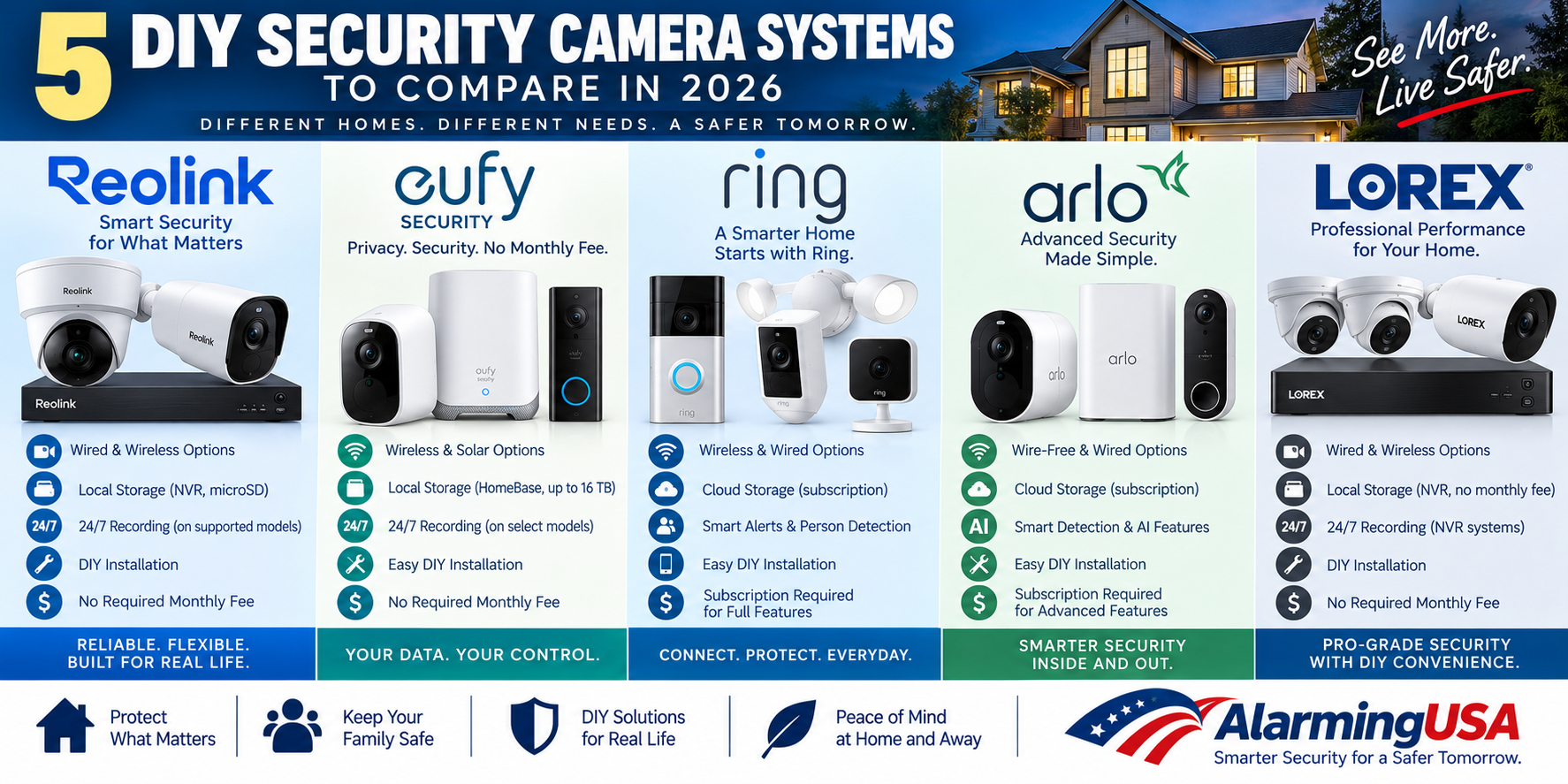
These five systems take different approaches to home video security. Reolink and Lorex offer extensive local-recording options, eufy emphasizes local storage and a broad wireless ecosystem, Ring integrates closely with its doorbells and alarm products, and Arlo focuses heavily on wire-free cameras and cloud-based smart features.
1. Reolink
Reolink offers PoE, plug-in Wi-Fi, battery, cellular, NVR, and Home Hub products. For users who want local recording, compatible Reolink cameras can record continuously to a microSD card, NVR/Home Hub, computer, FTP server, or supported third-party software.
Things to consider: Reolink provides many choices for users who want local storage or a traditional multi-camera NVR. Continuous recording depends on the camera and storage device, and most battery-powered models are designed around event recording rather than uninterrupted 24/7 video.
2. eufy Security
eufy Security offers battery, solar, indoor, outdoor, doorbell, and other DIY cameras. Its HomeBase S380 provides centralized local storage with 16 GB built in and supports expansion up to 16 TB with a compatible storage drive.
eufy emphasizes local security without a required monthly storage fee on compatible systems. Certain wired cameras can also store 24/7 recordings through HomeBase S380.
Things to consider: eufy can be attractive for households that want wireless cameras and local storage while minimizing recurring fees. Camera compatibility and recording modes should be checked for the exact model.
3. Ring
Ring has a large DIY ecosystem that includes indoor and outdoor cameras, video doorbells, lighting, and Ring Alarm. The Ring app provides a common interface for compatible devices, making Ring especially relevant for households already using its doorbells or alarm equipment.
Ring cameras can provide certain functions without a paid plan, but recorded video history and many advanced features require a Ring Protect subscription. Ring also offers 24/7 continuous recording on eligible cameras as a paid add-on.
Things to consider: Ring offers strong ecosystem integration and simple app-based management, but users who want recorded video and advanced features should include subscription costs in their comparison.
4. Arlo
Arlo offers wire-free, wired, indoor, outdoor, doorbell, and other camera products. Its subscription services add cloud video history and smart detection features. As of September 2026, Arlo has introduced updated plan names and additional Early Warning System features.
Arlo cameras can retain basic capabilities without a paid plan, including live streaming, push notifications, and two-way audio on supported devices. Local recording is available only on compatible equipment and configurations.
Things to consider: Arlo’s wireless design and smart features can be appealing, but many cloud-history and advanced detection capabilities depend on a subscription.
5. Lorex
Lorex is particularly established in wired IP camera and NVR systems. Its recorders store footage locally on surveillance hard drives and are designed for continuous operation. Lorex also sells Wi-Fi cameras and hybrid systems.
Lorex currently emphasizes local recording without required monthly cloud subscriptions on its recorder-based systems. Many NVR packages include a hard drive and support expandable storage.
Things to consider: Lorex is worth examining when continuous local recording and a larger multi-camera installation are priorities. Wired installations can require more work than battery-camera systems because cables need to reach camera locations.
DIY Security Camera System Comparison
| System | Local Storage | 24/7 Recording | Subscription Considerations | Notable Area |
|---|---|---|---|---|
| Reolink | Yes | Yes, on compatible models | Local options can reduce cloud dependence | PoE, NVR and flexible local recording |
| eufy Security | Yes | Yes, on compatible wired models | No required monthly fee for core local-storage use | Wireless/solar plus HomeBase local storage |
| Ring | Limited/configuration dependent | Available on eligible cameras with paid add-on | Recording history and advanced features generally use Protect plans | Ring doorbell and alarm ecosystem |
| Arlo | Available on compatible setups | Plan/device dependent | Cloud history and many advanced features use paid plans | Wire-free cameras and smart cloud features |
| Lorex | Yes | Yes, with compatible recorder systems | Recorder-based local storage does not require a monthly cloud fee | Large wired NVR installations |
What Should You Compare Before Buying?
- Local vs. cloud storage: Decide whether you want footage stored at home, in the cloud, or both.
- Subscription cost: Check which recording and detection features continue working without a monthly plan.
- Continuous vs. event recording: Battery cameras commonly prioritize motion events, while powered cameras are better suited to continuous recording.
- Wired vs. wireless: PoE can provide reliable power and data, while battery and solar cameras simplify installation.
- Video resolution: Compare resolution together with night performance, field of view, frame rate, and compression.
- Storage capacity: Multi-camera continuous recording can require substantial storage.
- Smart detection: Determine whether person, vehicle, package, pet, or other detection features require a subscription.
- Expansion: Consider how easily additional cameras, doorbells, or other security devices can be added later.
Local Storage vs. Cloud Storage
Local storage can reduce recurring costs and keep recordings on equipment in your home. Reolink, eufy, and Lorex all offer substantial local-storage options. Cloud-focused services can make remote video history and smart features convenient, but recurring subscription fees should be included when comparing long-term cost.
Battery Cameras vs. PoE Cameras
Battery and solar cameras are convenient when running cable would be difficult. However, battery conservation means many models rely primarily on motion-triggered clips. PoE cameras receive power and data through Ethernet and are commonly paired with NVRs for continuous multi-camera recording.
Which Type of Camera System Fits Your Project?
A user planning a larger wired installation may want to compare Reolink and Lorex recorder systems closely. Someone prioritizing wireless cameras with expandable local storage may want to examine eufy’s HomeBase ecosystem. Existing Ring users may value having cameras, doorbells, and alarm devices in one ecosystem, while Arlo users may place greater value on wire-free installation and cloud-based smart features.
Final Thoughts
Reolink, eufy Security, Ring, Arlo, and Lorex all offer viable DIY camera ecosystems, but their approaches to storage, subscriptions, wiring, and continuous recording differ considerably. Start by deciding whether you want local or cloud storage and whether you need continuous recording. Those two choices can narrow the field quickly.
As AlarmingUSA adds individual reviews and installation guides for these brands, this comparison can serve as a central resource linking to more detailed camera setup, storage, networking, and troubleshooting articles.
Comments are closed.